
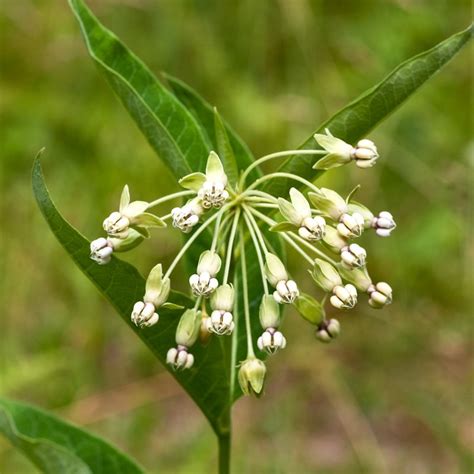
 poke Milkweed (Asclepias exaltata)
Milkweed is the essential host plant for monarch caterpillars and a nectar source for many pollinators. All of our milkweeds are hardy perennials that return year after year once established.
plant profile
Poke Milkweed is a graceful native perennial with broad leaves and loose, drooping clusters of white flowers touched with green, pink, and purple. Unlike many milkweed species that naturally grow in open, sunny areas, Poke Milkweed is a woodland species commonly found along forest edges, openings, slopes, and other partially shaded habitats. Its tall, elegant growth and nodding flowers give it a distinctive appearance in woodland and native gardens.
Growing conditions
- Size: 3 to 5 feet tall, 1 to 3 feet wide
- Light: Partial shade to dappled sun
- Soil: Well drained soil
- Water: Moderate; water during extended dry periods once established
- Bloom time: Summer
- Lifecycle: Perennial
planting instructions
- Plant in spring or fall when temperatures are mild
- Dig a hole slightly wider than the root ball and set the crown level with the soil surface
- Space plants about 18-24 inches apart
- Water thoroughly after planting and regularly while the plant becomes established. Reduce supplemental watering once established.
- Choose a location with partial shade or dappled sunlight and well drained soil.
seasonal growth pattern
- Year 1: Focuses on establishing its root system and top growth; flowering may be limited while the plant becomes established.
- Year 2: Produces stronger growth and more reliable flowering.
- Year 3 and beyond: Returns reliably each spring with established growth and produces its characteristic loose, drooping flower clusters during summer.
- Fall & Winter: Seed pods mature and split to release wind dispersed seeds. Above ground growth dies back for winter and returns in spring.
care
Poke Milkweed performs best in partial shade or dappled sunlight and well drained soil. Once established, it generally requires little supplemental watering, although additional water may be helpful during extended dry periods.
notes
- Naturally occurs in woodlands, forest openings, and along woodland edges.
- Produces loose, drooping clusters of white flowers touched with green, pink, and purple.
- One of the better milkweed choices for partially shaded or woodland gardens.
- Its broad leaves resemble those of pokeweed, which is the origin of its common name.